Legal and Judicial
Published 27 August 2026 · Last updated 27 August 2026
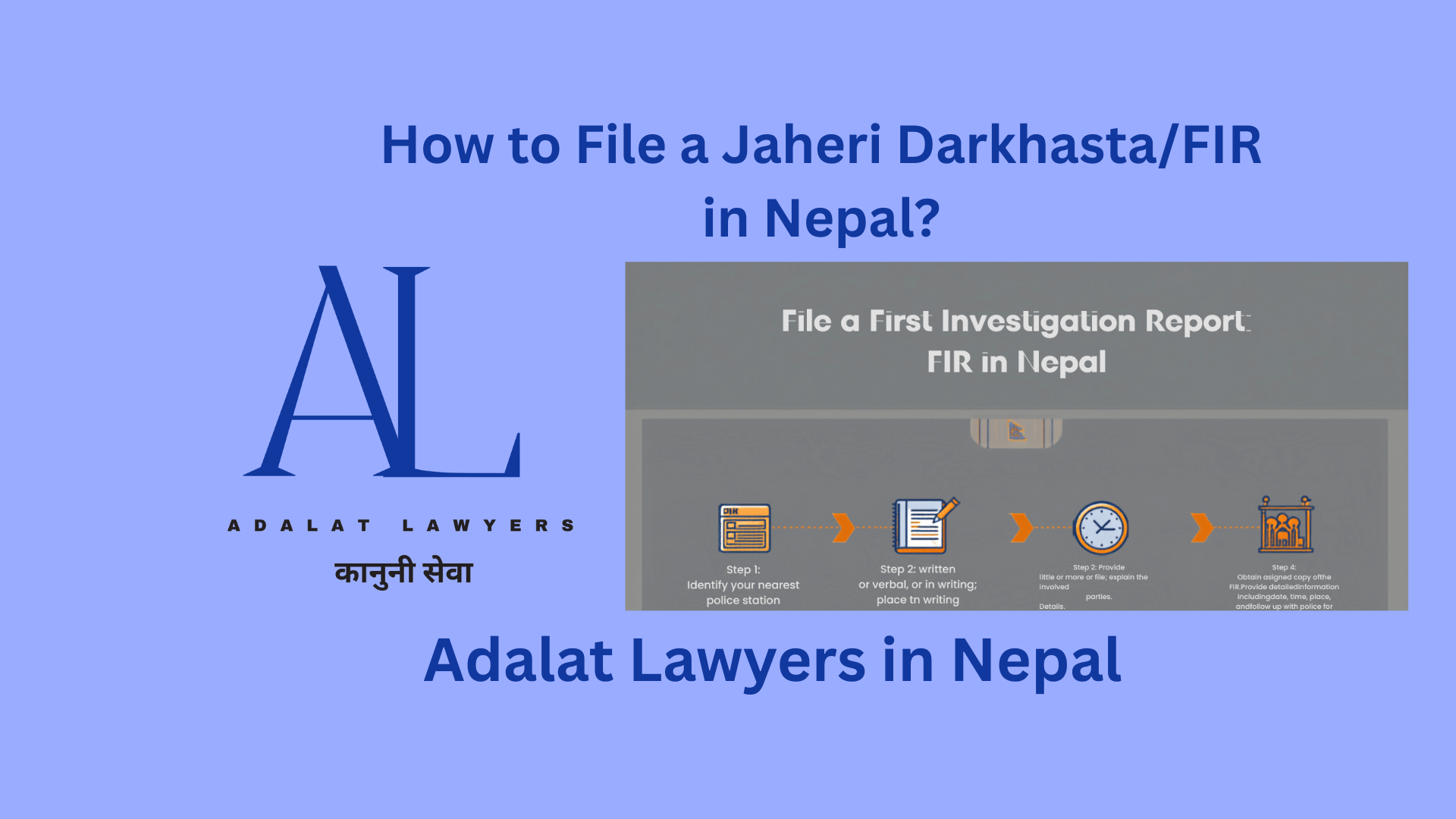
A Jaheri Darkhasta (जाहेरी दरखास्त), commonly understood as a First Information Report (FIR) or first information about the commission of a criminal offence, is the formal information given to the competent authority regarding an offence committed, being committed, or likely to be committed. In Nepal, the principal procedural law governing the registration and investigation of criminal offences is the Muluki Criminal Procedure Code, 2074 (2017). The Nepal Law Commission lists the Code as the applicable criminal procedural legislation.
Section 4 of the Muluki Criminal Procedure Code, 2074 provides that a person who knows that an offence listed in Schedule-1 has been committed, is being committed, or is likely to be committed shall, as soon as possible, make a first information report in writing or provide information verbally or through electronic means to the nearby police office, together with available proof or evidence. The information is to be given in the form prescribed in Schedule-5. The police must register the information and provide a receipt in the prescribed form under Schedule-6.
A Jaheri Darkhasta starts the formal criminal investigation process. It does not itself establish the guilt of the accused. After registration, the investigating authority collects evidence, examines witnesses, conducts searches or seizures where legally permitted, and takes other investigative steps according to the nature of the offence. Adalat Lawyers in Nepal.
A Jaheri Darkhasta in Nepal is a first information report or information concerning the commission, ongoing commission, or likely commission of a criminal offence. Section 4 of the Muluki Criminal Procedure Code, 2074 governs the procedure for providing this information. A person who knows about a Schedule-1 offence may submit the information to the nearby police office in writing, verbally, or through electronic means, along with available evidence.
The purpose of a Jaheri Darkhasta is to bring information about an alleged criminal offence before the competent investigative authority. Once received, the police office must register the information and provide a receipt. The police must also enter the information into the prescribed register. Depending on the offence, the information may be forwarded to a separate investigating authority or the concerned district police office. Therefore, FIR registration is the beginning of investigation rather than a determination that the accused is guilty.
The principal legislation governing FIR filing in Nepal is the Muluki Criminal Procedure Code, 2074 (2017). Chapter 2 contains provisions relating to information concerning the commission of offences and investigation. Sections 4 and 5 are particularly relevant to filing and refusal to register a first information report. Sections 6 to 18 contain provisions concerning preservation of evidence, investigation, arrest, preliminary investigation, detention, interrogation and search.
Section 4 establishes the basic right and procedure for providing information about Schedule-1 offences. Section 5 provides a complaint mechanism when a police office refuses to register the FIR. Section 6 deals with measures to prevent destruction or concealment of evidence and escape of offenders. Section 8 regulates collection of proof and evidence during investigation.
The Criminal Offences Investigation Rules, 2075 also provide procedural rules concerning investigation. The Nepal Law Commission identifies the relevant criminal procedural legislation and regulations in its official legal repository.
A person who knows that a Schedule-1 offence has been committed, is being committed, or is likely to be committed can provide a first information report or information under Section 4. The provision does not limit the reporting function only to the direct victim. Therefore, a person having knowledge of the alleged offence may provide information to the police.
The informant should provide facts within his or her knowledge and submit whatever proof or evidence is in his or her possession or has been seen or known. The person making the report should distinguish between facts personally known and information received from other sources.
For offences under Schedule-2, Section 4 provides a separate procedure. Information must generally be given to the office or authority empowered by law to investigate that offence. If immediate registration by that authority is not possible, information may also be given to the nearby police office, which must register it and forward it to the concerned authority within the statutory period.
For a Schedule-1 offence, Section 4 provides that the first information report may be given to the nearby police office. The information can be submitted in writing, verbally, or through electronic means. The police office receiving the information must register it and provide a receipt.
Jurisdictional location can become relevant after the information is received. Section 7 provides that where the police office learns that an offence occurred within the area of another police office, it should send the information to the concerned police office and inform the informant to appear there when necessary.
The law also recognizes situations involving geographical remoteness or temporary unavailability of the investigating authority. In such circumstances, the police office receiving the information may undertake preliminary investigation where immediate action is required to prevent escape of an offender or disappearance of evidence, while informing the concerned and higher police authorities.
A Jaheri Darkhasta is generally used to report offences falling within the criminal procedure framework, particularly offences listed in Schedule-1 of the Muluki Criminal Procedure Code, 2074. Section 4 expressly provides the procedure for reporting an offence listed in Schedule-1.
The specific offence should be identified by reference to the applicable substantive criminal law, principally the Muluki Criminal Code, 2074, or another special criminal statute where applicable. Examples of criminal conduct may include offences against life, bodily integrity, property, sexual offences, fraud, forgery, violence, narcotic offences and other offences depending upon the applicable legislation.
Schedule-2 offences follow a different reporting mechanism because the law may designate a specific office or authority to investigate them. Therefore, a person should identify the legal classification of the alleged offence before submitting the complaint. Filing before the wrong authority may result in transfer or referral rather than immediate investigation by that office.
A person filing a Jaheri Darkhasta in Nepal should provide sufficient information to identify the alleged offence and support the investigation. Section 4 requires the informant to provide whatever proof or evidence is in his or her possession or whatever evidence the person has seen or known.
Documents and materials may include:
The informant should preserve original evidence safely and provide copies where appropriate. Evidence should not be altered, destroyed or fabricated. The police may independently collect and seize relevant exhibits during investigation under the authority provided by law.
A Jaheri Darkhasta format in Nepal should present the facts clearly, chronologically and accurately. Section 4 refers to the form prescribed under Schedule-5. The Criminal Offences Investigation Rules, 2075 further provide that a complaint should be received even where it does not exactly follow the Schedule-5 format, and the concerned authority may seek clarification where additional information is necessary.
A properly prepared complaint should generally identify the informant, explain the alleged incident, identify the accused where known, state the date, time and location, describe the acts constituting the alleged offence, identify witnesses and list available evidence.
The complaint should contain facts rather than exaggerated allegations. False or fabricated information can create separate legal consequences.
The procedure for filing FIR with Nepal Police begins with submitting information about the alleged offence to the appropriate police office. Section 4 allows information to be provided in writing, verbally or through electronic means for Schedule-1 offences.
If information is provided electronically, Section 4 requires acknowledgement through the same means. The police must enter the report or information into the prescribed register under Schedule-7.
After registration of a Jaheri Darkhasta, the competent authority begins the investigation process according to the offence and applicable law. Section 8 provides that, after receiving information regarding a Schedule-1 offence, the concerned police office should designate an investigating authority as soon as possible. Generally, the designated investigating employee must have a rank of at least Assistant Sub-Inspector, while specified serious offences require investigation by an officer of at least Inspector rank.
The investigating authority may prepare a scene-of-crime deed, collect exhibits and evidence, photograph relevant locations or marks, examine witnesses, conduct searches and seize relevant evidence where statutory requirements are satisfied.
Section 10 requires preliminary investigation to begin immediately after registration and provides that the preliminary investigation report must generally be forwarded to the district government attorney office within three days. The government attorney may issue reasoned instructions for further investigation.
Section 4 does not prescribe a general fixed number of hours for registering every Schedule-1 FIR after submission. It requires a police office receiving the first information report or information to register it and issue the prescribed receipt. The law therefore establishes a registration obligation rather than a universal processing period applicable to every factual situation.
For Schedule-2 information, Section 4 provides that where immediate registration by the designated office or authority is not possible, information may be given to the nearby police office. That police office must register the information and forward it to the concerned office or authority not later than three days.
After registration, investigation has separate statutory requirements. Section 10 provides that preliminary investigation must commence immediately and that the preliminary investigation report is generally forwarded to the district government attorney office within three days. These periods should not be confused with the total duration of a criminal investigation or prosecution.
There is no general FIR registration fee specified in Section 4 of the Muluki Criminal Procedure Code, 2074 for submitting a first information report concerning a Schedule-1 offence. The statutory procedure requires the police to register the information and provide a receipt.
Therefore, a person should distinguish between the government registration of a Jaheri Darkhasta and separate expenses that may arise from obtaining documents, medical examinations, copies, legal representation, travel or other services connected with the matter.
A lawyer's professional fee is also separate from any government charge. The exact cost of legal assistance depends upon the nature and complexity of the criminal matter, the amount of investigation required and the services requested.
A person should request an official receipt for any government payment made in connection with a legal service and should not treat an unofficial payment as a statutory FIR registration fee.
Section 5 provides a specific remedy where the concerned police office refuses to register a first information report made or information given under Section 4(1). The person may make a complaint concerning the refusal to the concerned District Government Attorney Office or to a police office higher in level than the police office that was required to register the FIR.
Under Section 5, the receiving authority maintains a record and forwards the first information report or information to the concerned police office for necessary action. The police office must then register and act according to Section 4(3).
Different authorities may become involved depending upon the offence. For Schedule-1 offences, the nearby or concerned police office receives and registers the first information report. The concerned district police office may become responsible where the offence falls within its jurisdiction.
The investigating authority conducts the investigation. The District Government Attorney Office receives preliminary investigation reports and may issue reasoned instructions concerning further investigation. For Schedule-2 offences, the authority specifically empowered by law investigates the offence.
The adjudicating authority becomes involved in matters such as arrest warrants and detention remand where required by the Criminal Procedure Code. The law therefore separates reporting, investigation, prosecution-related functions and judicial authorization.
A Jaheri Darkhasta does not itself constitute a court case. It initiates or facilitates the statutory investigation process, after which the competent authorities determine the subsequent legal steps according to the evidence and applicable law.
A lawyer can provide legal assistance before, during and after filing a Jaheri Darkhasta in Nepal. Legal assistance may include reviewing the facts, identifying potentially applicable offences, preparing the written complaint, organizing documentary and electronic evidence, advising on the appropriate police office and assisting where registration is refused.
Lawyers may also communicate with investigative authorities on behalf of clients where legally permitted, assist clients during investigation, review statements and help protect procedural rights. Where arrest, detention, remand or prosecution proceedings arise, a criminal lawyer can represent the accused or other legally entitled party before the appropriate authority or court.
Adalat Lawyers in Nepal can assist with criminal complaint drafting, FIR/Jaheri Darkhasta filing, evidence organization, police-related legal proceedings, criminal investigation matters, bail and detention proceedings, and representation in criminal cases.
Legal advice should be based on the facts of the particular case because the applicable offence, authority, limitation provisions and evidence requirements can differ substantially.
Before filing a Jaheri Darkhasta/FIR in Nepal, the informant should prepare accurate information and preserve all available evidence. The objective is to give the investigative authority sufficient factual information to understand the alleged offence and begin appropriate investigation.
The receipt should be preserved because it provides evidence that the information was submitted and registered.
A Jaheri Darkhasta is a first information report or information concerning a criminal offence. Under Section 4 of the Muluki Criminal Procedure Code, 2074, a person knowing about a Schedule-1 offence may provide information to the nearby police office in writing, verbally or electronically. The police must register the information and provide the prescribed receipt.
A person who knows that a Schedule-1 offence has been committed, is being committed or is likely to be committed may provide information under Section 4. The person does not necessarily have to be the direct victim. The informant should provide available evidence and accurately disclose facts known to him or her.
For Schedule-1 offences, an FIR may be submitted to the nearby police office under Section 4. If the offence falls within another police office's area, Section 7 provides procedures for forwarding the information to the concerned police office. Schedule-2 offences generally require reporting to the authority legally empowered to investigate them.
The specific documents depend on the offence. Generally, an informant should provide identification, the written Jaheri Darkhasta, relevant contracts or transaction records, photographs, videos, medical documents, electronic communications, financial records and witness information where available. Section 4 specifically requires submission of whatever proof or evidence the informant possesses or has seen or known.
The Muluki Criminal Procedure Code, 2074 does not prescribe a general FIR registration fee under Section 4 for a Schedule-1 offence. Separate expenses may arise for document copies, medical examinations, travel or legal services. A lawyer's professional fee is also separate. Any government payment should be supported by an official receipt.
Section 4 requires the police office receiving information about a Schedule-1 offence to register it and provide a receipt. It does not establish one universal number of hours for every FIR. For certain Schedule-2 information initially given to police because the competent authority cannot immediately register it, the police must forward it within three days.
If the concerned police office refuses to register a first information report under Section 4(1), Section 5 provides a complaint mechanism. The informant may complain to the concerned District Government Attorney Office or a higher-level police office, attaching the refused FIR or information. The receiving authority must record the complaint and initiate the statutory process.
After FIR registration, the competent investigating authority conducts investigation according to law. It may inspect the crime scene, collect evidence, examine persons, conduct searches, seize relevant exhibits and take other lawful investigative measures. Section 10 requires preliminary investigation to begin immediately and generally requires its report to be forwarded to the District Government Attorney Office within three days.
A lawyer can assist with preparing and submitting a Jaheri Darkhasta and may provide legal representation or advice concerning the investigation. However, the factual information must come from the person who knows the circumstances, and the applicable procedural requirements must be followed. The lawyer should not include false or fabricated facts in the complaint.
If there is a risk that an accused person may escape or evidence may disappear, the police have statutory powers to take preventive investigative measures. Section 6 requires police to take effective steps to prevent an offender from escaping and evidence from being concealed or destroyed. Arrest and warrant procedures are separately governed by Section 9 and related provisions.
Filing a Jaheri Darkhasta/FIR in Nepal is the statutory method for bringing information about a criminal offence before the competent investigative authority. Under Section 4 of the Muluki Criminal Procedure Code, 2074, information regarding a Schedule-1 offence may be given in writing, verbally or through electronic means to the nearby police office, together with available evidence. The police must register the information, provide a receipt and enter it in the prescribed register.
If the police refuse to register the FIR, Section 5 provides a specific complaint mechanism through the District Government Attorney Office or a higher-level police office. For Schedule-2 offences, the law provides a separate reporting and investigation mechanism through the authority designated by law. Sections 6 to 18 establish further rules concerning evidence preservation, investigation, arrest, preliminary investigation, detention, interrogation and search.
A person filing a Jaheri Darkhasta in Nepal should provide accurate facts, identify available evidence and preserve supporting documents. False, deceptive or fabricated information should not be submitted. Section 11 provides a mechanism concerning information that appears deceptive, false or fabricated, allowing the concerned authorities to consider whether further investigation is warranted.
For legal assistance with Jaheri Darkhasta drafting, FIR filing in Nepal, criminal complaint registration, police investigation, evidence preparation, FIR refusal complaints, criminal cases, arrest and detention matters, Adalat Lawyers in Nepal can provide legal assistance based on the facts and applicable law of the individual case.
The applicable law and procedural requirements can change through amendments or special legislation. For that reason, the current statutory text and the specific facts of the case should be checked before filing a criminal complaint. The Nepal Law Commission currently lists the Muluki Criminal Procedure Code, 2074 as the relevant legislation.
Subscribe for a monthly briefing on Nepal's corporate law, regulatory developments, and firm insights.
Download a PDF copy of this publication to read offline or share with colleagues.
Download PDFInsights